
What Everyone Gets Wrong About David and Goliath
It's not about facing your giants. It's about who already did.

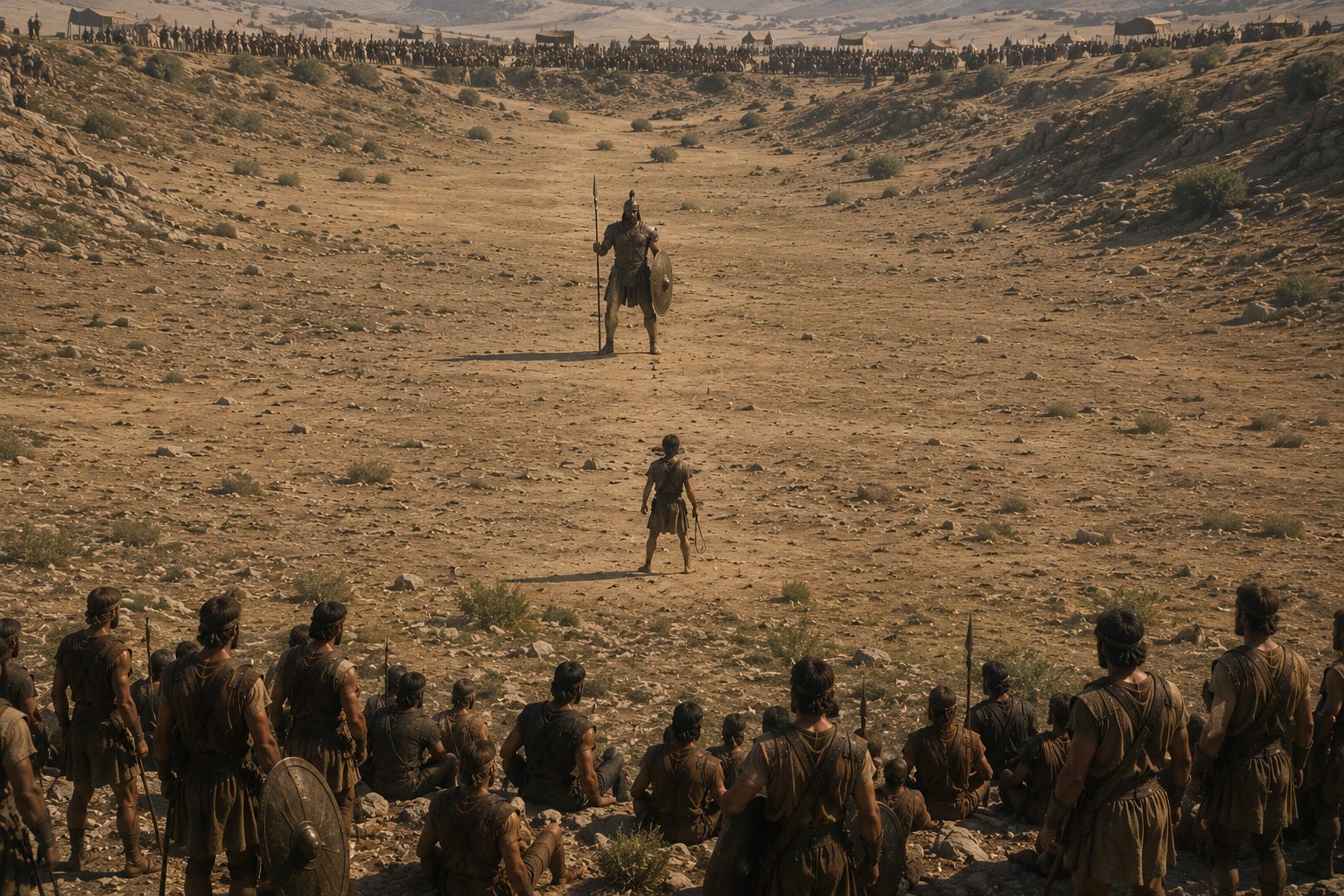
Everyone loves an underdog story. And David and Goliath is the underdog story. Small shepherd boy. Towering giant. A sling and five stones. Against all odds, the little guy wins.
We learned it in Sunday school. We’ve seen it in ESPN highlight reels and motivational speeches and graduation sermons. It’s become cultural shorthand for every situation where the weak somehow take down the strong.
And because of that, most of us walk into 1 Samuel 17 thinking we already know what it says.
But we don’t.
Because underneath the story everyone knows, there’s a detail hiding in plain sight. A detail that makes this less about courage and more about something we all desperately need.
Every giant exposes the same thing. We need someone to fight what we can’t.
The Story Of David And Goliath
Israel is locked in a standoff with the Philistines. Two armies on opposite sides of a valley. And for forty straight days, a Philistine giant named Goliath walks out and issues the same challenge: Send me your best man. We’ll settle this one on one.
Goliath is massive. Draped in armor, a trained warrior from his youth. And for forty days, nobody moves.
Then David shows up… The youngest of his brothers, sent by his dad to deliver food to the front lines. He hears Goliath taunting Israel and he’s furious, so he volunteers to fight. Saul reluctantly agrees. David grabs five smooth stones and walks out to face the giant.
As he approaches the battlefield Goliath laughs at him.
But David doesn’t flinch. He responds, “You come at me with a sword and a spear, but I come at you in the name of the Lord Almighty.”
Then, before Goliath can even react, David moves.
He loads one stone and skillfully hurls it toward Goliath. The stone collides with Goliath’s forehead, bringing the giant crashing to the ground. David then picked up Goliath’s sword and cut off his head.
Then everything changes. The army that once cowered in fear erupts in victory, all because one boy had the courage to trust God when no one else did.
End of story. Little guy wins. Therefore we should trust God and face your giants. The end.
Except it’s not the end. And the real point of this story has almost nothing to do with courage.
The Detail Nobody Talks About
The real question here is, why was no one stepping up?
Israel had soldiers, weapons, and trained men of war. Yet for forty days Goliath taunted them morning and evening, and not one person moved. That seems strange until you notice something the text has been setting up since chapter 8.
Israel had a king.
Not just any king; a king they had begged God for. Argued for. Demanded. Because they wanted to be like the surrounding nations, and surrounding nations had kings who led them into battle. That was the whole arrangement. You give us a king, he fights for us. He stands between us and whatever is threatening us. He’s our champion.
And that king’s name was Saul.
Here’s where it gets uncomfortable. Saul was taller than every other man in Israel, the text makes a point of telling us this in 1 Samuel 9:2. He was physically imposing. He was the king. When Goliath called out in 1 Samuel 17:8, “Choose a man and have him come down to me,” the text seems to be pointing toward Saul as the one who should have stepped forward.
And for forty days, Saul hid.
Not because he lacked soldiers. Not because he lacked resources. Because he lacked the willingness to stand in the gap between his people and the thing threatening them. He was supposed to be their champion. Instead, he offered money and his daughter to anyone else brave enough to do what he should have done himself.
Here’s the reality. We all know what it’s like to have a giant we won’t face.
I’ve spent more of my life than I’d like to admit pretending certain things weren’t there. Patterns I knew needed to change. Sin I kept rationalizing. Shame I’d gotten good at managing instead of bringing into the light. Not because I didn’t know better. Because facing it for real felt like walking into a valley alone against something I wasn’t sure I could beat.
That’s the army of Israel on that hillside. They had a giant they knew they couldn’t defeat themselves. So they hid.
When David Steps In
So David steps up. And this is where the story gets genuinely surprising, not because of what David does, but because of what his victory means for everyone watching.
Before David walks into the valley, he tells Saul about his time in the wilderness keeping his father’s sheep. In 1 Samuel 17:34-36 he says:
“When a lion or a bear came and carried off a sheep from the flock, I went after it, struck it and rescued the sheep from its mouth. When it turned on me, I seized it by its hair, struck it and killed it. Your servant has killed both the lion and the bear.”
He’s not naive nor is he just lucky. He has been forged in the wilderness in ways nobody counted. God was building something in him out in those fields — skill, faith, a specific kind of courage — that none of his brothers recognized and that Saul certainly didn’t expect.
And that sling wasn’t a child’s toy. Armies in the ancient world had entire specialized units of slingers because a trained slinger with a smooth stone was a devastating weapon at long range. David wasn’t being reckless when he refused Saul’s armor. He was dictating the terms of the fight.
But here’s the thing. None of that is the real point.
When David walked into that valley, he wasn’t just fighting as an individual. In ancient warfare, this kind of single combat had a specific logic and a specific name. The two sides each send a champion, a representative, and the outcome of their fight gets transferred to everyone they represent. The champion fights. Everyone else inherits the result.
So when David’s stone sinks into Goliath’s forehead, something transfers to every terrified soldier watching from the hillside. And the moment Goliath fell, they got to chase the Philistines off the field. David’s victory became their victory.
Sit with that for a second. Because that’s not just a military detail. That’s the architecture of everything that’s about to happen at the center of human history.
David is not a permanent solution. David the giant-killer becomes David the king, and then David the adulterer, David the murderer, David the man who abuses his power to cover his own sin. The champion who stepped in for Israel will, within just a few chapters, desperately need a champion of his own. The man who ran toward Goliath will run from his own failures in the years to come.
Every giant David killed got replaced by another. Every victory eventually faded.
The Pattern That Keeps Repeating
This is actually Israel’s whole story. Read the Old Testament and you see it cycling on a loop.
Giant appears. Champion steps up. Champion wins. Champion fails. New giant appears. Repeat.
Judge after judge. King after king. Each one stepping into the gap, winning something temporary, and eventually becoming part of the problem themselves.
And the deeper issue never gets fixed. The human heart. Paul names it directly in Romans 7:19:
“For I do not do the good I want to do, but the evil I do not want to do—this I keep on doing.”
Paul is describing everyone who has ever looked at their own patterns and asked, why do I keep going back to this?
That’s not a David and Goliath problem. That’s a human problem. And no human champion, no matter how skilled, how faithful, how brave, has ever been able to fix it from the outside in.
David defeats one giant. The heart that keeps producing giants doesn’t change.
What we need isn’t another David. What we need is someone who can fight what David couldn’t.
The Greater David
Then Jesus shows up and everyone expects another warrior king. Another David. Someone to raise an army, defeat Rome, restore the throne, give Israel back their dignity. A champion they can rally behind.
What they get instead is a man who walks voluntarily into the valley alone. Not to face a Philistine giant. To face the real giants, the ones that have been crouching behind every other enemy since the beginning.
Sin. Shame. Death itself.
Tim Keller said it this way: “Jesus is the true and better David, whose victory becomes his people’s victory, even though they never lifted a stone to accomplish it themselves.”
Jesus steps into the space between us and everything that has ever threatened to undo us. He fights on our behalf. And what happens to him gets transferred to everyone he represents… his victory, his defeat of sin and death, gets credited to us.
We didn’t fight. We were on the hillside. He stepped in.
And unlike David, this champion doesn’t eventually fail. The giant doesn’t get back up. The victory doesn’t erode over time. Death has been defeated permanently and the one who defeated it walked out of the tomb and is still standing.
Paul puts it in Romans 8:1 with a sentence that should feel like something being lifted off your chest:
“Therefore, there is now no condemnation for those who are in Christ Jesus.”
No condemnation. Not less condemnation. Not condemnation you have to keep fighting off every morning before breakfast. None.
Because your champion already went into that valley. And he won.
What You Do With This
Here’s the temptation when you read a story like this. You want to be David. You want to find the courage to run toward your giant, to be the one who steps up when everyone else is backing away.
That’s not a bad impulse. But I think it’s the wrong starting point. The most important thing this story asks of you isn’t courage. It’s honesty.
Be honest about which side of the valley you’re on.
Because most of us, if we’re actually telling the truth, are Israel. We’re on the hillside. We’ve been staring at something that has paralyzed us. A pattern we can’t break. A shame we can’t shake. Something we’ve tried to fight in our own strength more times than we can count, and it keeps winning. And we’ve quietly started to wonder if it always will.
I know that feeling. And if that’s where you are, I want you to hear this: the army of Israel wasn’t condemned for standing on that hillside. They were delivered. Someone stepped in for them. They didn’t have to become brave enough or strong enough or good enough first. They just had to receive what the champion won on their behalf.
That’s still how it works.
If you’re a follower of Jesus, here’s what this means practically. Stop trying to summon enough courage to fight your own giants as your first move. That’s not the gospel. The gospel is that your champion has already fought and won. What actually changes you isn’t trying harder, it’s letting that reality go deeper. It’s returning again and again to the fact that there is no condemnation. That the victory has already been credited to your account. That you are not fighting for your standing before God. You’re fighting from it.
You’re not Israel on the hillside before the battle. You’re Israel chasing the Philistines after it. The giant is already down. Live like it.
And if you’re not yet a follower of Jesus, if you’re reading this from the outside, I want you to notice what this story keeps surfacing. Every giant exposes the same need. Someone willing to step into the space we can’t cross ourselves. Someone with enough power to fight what we can’t. Someone willing to absorb the full cost of the battle so we don’t have to.
Whatever you’ve been carrying. Whatever keeps winning when you try to fight it alone. Whatever you’ve looked at and quietly thought, I don’t think I can beat this… There is a valley. There is a giant. And there is a champion who already walked in. And he’s still standing.
If this kind of teaching is helpful, paid subscribers get a second post every Thursday focused on what Scripture actually means for how you live. $6 a month (or 3 months free when you pay annually). I’d love to have you.
If this was helpful, pass it along to someone who might need it.
This whole teaching.....
SUPER helpful.
Thank you.
So true! We need a proper perspective of this story. Thanks for sharing this. God is the ultimate hero, and David points forward to Jesus.